This morning when I'm checking on the chickens, I noticed that the buff/brown Turken had a spot of fresh blood on her neck. Looks like one of the other birds was being a little rough in determining pecking order.
I took her out of the pen, cleaned up her wound and put some anti-biotic ointment on it. When I get home from work tonight, I'll check to see if she's still being picked on. If so, I'll have to separate her for a few days in one of the old tubs until she heals. From what I've read, the omnivores can keep pecking at wounds until they kill the bird. I'd be bummed if that happened.
Tuesday, February 15, 2011

Tuesday, February 8, 2011
They Grow Up So Fast (part 3)
 I'm still not sure which black ones are Jersey Giants or Australorps...they look the same to me. A little bit of research will tell me the difference, but I just haven't gotten that far yet.
 You'll also notice in the picture that Aussie has jacked up toes. I guess I should have been paying attention while she was younger so I could have corrected that. But she gets around fine, so no worries.
  The turkens are still my favorites right now. They look cool and seem to have the best temperment. Not that any of them are mean or agressive (well, the roosters are all agressive, but not in a "I'm gonna cut you" kind of way).
 Mystery chick is still a mystery. I'm going to post her picture on backyard chickens to see if someone can identify what she is. I'll update y'all later with the results.
 Random Jersey Giant rooster. He was the calmest of all the chickens that got their pictures taken today. I think he was looking for a hand out. He got treats (meal worms and corn) when he was put back. Gotta fatten him up for freezer camp in a few months.
 And here they all are in their home in the basement. Even with the cold weather it's been in the mid-30s in the room...and around 45-50 where the heat lamp is. Once it warms up this week, I think I'm going to test them without the heat lamp at night.
 |
| Red at 6.5 weeks |
Two weeks later, so that means new pics of the chicks. Nice rhyme.
It is pretty interesting watching them grow up, though. Hard to believe that just seven weeks ago I still only had eggs.
 |
| Red at 6.5 weeks |
Red has turned into a good looking boy. Too bad that means rehoming or sending him off to freezer camp in a couple of month.
Aussie is still the smallest chicken in the coop, so she's easy to pick out.
 I'm still not sure which black ones are Jersey Giants or Australorps...they look the same to me. A little bit of research will tell me the difference, but I just haven't gotten that far yet.
 Well...that took about 15 seconds. The difference (besides adult size) is the foot color. The Australorps have black feet; the Jersey Giants are gray.
 You'll also notice in the picture that Aussie has jacked up toes. I guess I should have been paying attention while she was younger so I could have corrected that. But she gets around fine, so no worries.
  The turkens are still my favorites right now. They look cool and seem to have the best temperment. Not that any of them are mean or agressive (well, the roosters are all agressive, but not in a "I'm gonna cut you" kind of way).
 |
| Chickens like using power tools. |
 Mystery chick is still a mystery. I'm going to post her picture on backyard chickens to see if someone can identify what she is. I'll update y'all later with the results.
 Random Jersey Giant rooster. He was the calmest of all the chickens that got their pictures taken today. I think he was looking for a hand out. He got treats (meal worms and corn) when he was put back. Gotta fatten him up for freezer camp in a few months.
 And here they all are in their home in the basement. Even with the cold weather it's been in the mid-30s in the room...and around 45-50 where the heat lamp is. Once it warms up this week, I think I'm going to test them without the heat lamp at night.
 Tuesday, January 25, 2011
Crooked Leg - Dec 26 2010 - Jan 25 2011
Crooked Leg didn't make it. He had been getting weaker and weaker by the day. The move to the lower level didn't help, but I don't think he would have last too much longer anyway.
He was still alive when I got home from work, but wouldn't accept any food and only a little bit of water. I put him back in the brooder and went to have dinner and watched TV. When I went to check on the chickens a few hours later like I do every night (to tuck them in, so to speak) he was in the same spot, but he had died. When I took him out of the brooder he was still a little warm, so I'm guessing he passed some time around 8pm or so.
Over the past two days, I've been researching the fastest/most humane way to cull a chick. There are many ways to do it (some kind of gruesome, some not so bad). Ultimately, I didn't have to pick one of them. When the time comes to have to cull a chick in the future, I think I know which method I would use. I will definitely not wait so long as that is not really fair to the chick or me.
For the Office Skeptic - you can keep eating meat now. You don't have to think about what I may or may not have had to do.
RIP, Crooked Leg/Neck
He was still alive when I got home from work, but wouldn't accept any food and only a little bit of water. I put him back in the brooder and went to have dinner and watched TV. When I went to check on the chickens a few hours later like I do every night (to tuck them in, so to speak) he was in the same spot, but he had died. When I took him out of the brooder he was still a little warm, so I'm guessing he passed some time around 8pm or so.
Over the past two days, I've been researching the fastest/most humane way to cull a chick. There are many ways to do it (some kind of gruesome, some not so bad). Ultimately, I didn't have to pick one of them. When the time comes to have to cull a chick in the future, I think I know which method I would use. I will definitely not wait so long as that is not really fair to the chick or me.
For the Office Skeptic - you can keep eating meat now. You don't have to think about what I may or may not have had to do.
RIP, Crooked Leg/Neck
Sunday, January 23, 2011
They Grow Up So Fast (part 2)
The chicks I hatched are four weeks old and the turkens are now six weeks old. They are thriving and getting big (except Crooked Leg).
I've got them trained so whenever they see me, they start looking for food and treats. They are even to the point where they let me pet them and/or pick them up. Some are still skittish, but most aren't.
 |
| Mystery chick at four weeks. |
 | ||
| Aussie at four weeks. Still the smallest Australorp. |
 |
| Red @ four weeks |
 |
| Turkens @ six weeks |
 | |||||||||||||||||
Random chick that though the
|
Crooked Leg (nee Neck) Update
Crooked Leg isn't digging the new digs so much.
In the plastic bins, he didn't have to go far to get to the food, water and to stay warm. In the new brooder, these things are spread out more so he has to work a little harder to get what he needs. He peeps pretty much all the time (or at least I can hear him even before I go into the garage - yes, I can recognize his peep).
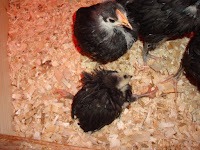 He has a really hard time getting around. My attempts at fixing his legs haven't worked. He's not strong enough to stand on the one good leg, and the other one just drags behind. He pulls himself around with the one good leg, and flaps his wings to help get moving. It seems like he expends a lot of energy doing this. He's about a third the size of his clutch-mates. All his intake goes towards the energy needed to get around.
I'm a bad flock steward and need to make a tough decision soon.
In the plastic bins, he didn't have to go far to get to the food, water and to stay warm. In the new brooder, these things are spread out more so he has to work a little harder to get what he needs. He peeps pretty much all the time (or at least I can hear him even before I go into the garage - yes, I can recognize his peep).
 He has a really hard time getting around. My attempts at fixing his legs haven't worked. He's not strong enough to stand on the one good leg, and the other one just drags behind. He pulls himself around with the one good leg, and flaps his wings to help get moving. It seems like he expends a lot of energy doing this. He's about a third the size of his clutch-mates. All his intake goes towards the energy needed to get around.
I'm a bad flock steward and need to make a tough decision soon.
Moving Day
The chicks are no longer living in the lower level of the house. The new brooder and chickens moved to the sub-garage on Saturday (1/22). They seemed to adapt pretty quickly after the initial shock of being shut into their plastic bins for the 90 second journey into the cold.
I was initially concerned about the temps down there. They were used to 70 degree temps in the house. It was a consistent 40 degrees with a heater running in the garage.
I rigged up the heat lamp, moved the heater next to the brooder, and blocked in the corner of the brooder where the chicks will hang out to try to keep the heat in. I checked on them every couple of hours over the weekend. The temp at the ground level is around 55 degrees in their corner. They huddle together when they aren't roaming around and scratching for food, jumping up on the roosts, and doing other chicken things.
With the move, all the chickens are now living together. It was interesting to note that the two turkens hang out together, and the other 12 hang out together. The only real exception so far is Mystery Chick. It goes and hangs out near the turkens from time to time. The turkens like to hang out in the right corner, opposite the heat. I'm not a chicken behaviorist so I'm not going to try to understand what's going on. As long as everyone is eating, drinking and not pecking at each other, then it's all good.
I was initially concerned about the temps down there. They were used to 70 degree temps in the house. It was a consistent 40 degrees with a heater running in the garage.
 |
| Brooder set up |
With the move, all the chickens are now living together. It was interesting to note that the two turkens hang out together, and the other 12 hang out together. The only real exception so far is Mystery Chick. It goes and hangs out near the turkens from time to time. The turkens like to hang out in the right corner, opposite the heat. I'm not a chicken behaviorist so I'm not going to try to understand what's going on. As long as everyone is eating, drinking and not pecking at each other, then it's all good.
Monday, January 17, 2011
New Birds
I think I may have started a new addiction. But I promise I won't get to the point of hoarding (see episode 40).

Last Saturday (January 8), I acquired two new chickens. They were 4

week old Turken (or Naked Neck) mutts. The best guess from the message boards is they were crossed with Leghorns based on some of the other characteristics. I don't know. Maybe. I just think they're kinda cool looking. Keep reading to find out why I know they are mutts.
How does one find Naked Neck chickens in the middle of winter in Minnesota? Craig's List. I was doing a random search for coops/sheds/playhouses - something I can get relatively inexpensively to house the chickens once they outgrow their brooder and keep them safe
 from predators/etc. Instead of finding a home, I found new chickens.
The guy (I'll call him the Random Russian) said he had a few of the breeds I would like to have in my flock - Turkens, Chantecler (because they are very cold hardy), and Brahmas (I think they are cool because of the feathered feet).
 On a side note, I've decided the direction for my flock is going to go in a different direction. At first I just wanted dual purpose chickens (both egg layers and good for meat) that were docile and good egg producers. Now, I've decided I want cool looking chickens. If I could have roosters, that would be much easier to accomplish, but with hens, they don't get the great coloring that the boys do.

The guy (I'll call him the Random Russian) said he had a few of the breeds I would like to have in my flock - Turkens, Chantecler (because they are very cold hardy), and Brahmas (I think they are cool because of the feathered feet).
 On a side note, I've decided the direction for my flock is going to go in a different direction. At first I just wanted dual purpose chickens (both egg layers and good for meat) that were docile and good egg producers. Now, I've decided I want cool looking chickens. If I could have roosters, that would be much easier to accomplish, but with hens, they don't get the great coloring that the boys do.
 Back on topic....During the course of our e-mail exchanges, I asked if he had some Chanteclers, Turkens and Brahmas. He said he had Turkens and Brahmas. I thought, great. Two more breeds I wanted to add to my growing flock. He explained he'd have some Chanteclers in the spring. I told him I'd be interested when they hatched out.
After a few e-mail exchanges (which I am know discovering that the person I was dealing with did not use English as his first language), I told him I would like the Turkens and Brahmas. He said he didn't have any Brahmas. My bad, I thought, but I still decided to drive up to Blaine and pick up a couple of Turken chicks. Before heading up there, I was trying to figure out how he kept chickens in Blaine. Is there farm land? I didn't think so, but what do I know
After a few e-mail exchanges (which I am know discovering that the person I was dealing with did not use English as his first language), I told him I would like the Turkens and Brahmas. He said he didn't have any Brahmas. My bad, I thought, but I still decided to drive up to Blaine and pick up a couple of Turken chicks. Before heading up there, I was trying to figure out how he kept chickens in Blaine. Is there farm land? I didn't think so, but what do I know
I enlisted a friend of mine to go with me on the trip to Blaine. You never know with this Craig's List stuff who you may run into. I had to promise her I would go out for cocktails the night before, so she stayed in the guest room so we'd be ready to go early.
I readied a box with some pine shavings and we left on the 45 minute road trip at 8:15. I met the Random Russian at his home - which turned out to be just a regular house in the middle of a suburban sub-division - and he directed me to wait outside the garage. Ah...now it is making sense.
He opened the garage door, we slid in - keeping an eye on the neighbors so we didn't look too shady. In a corner of the garage was a pretty sweet set up for the chicks he was trying to sell. It's what gave me the idea for my brooder. Anyway, in the brooder are a bunch of chicks. Right away I noticed one of the Turkens had feathery legs. That's not right.
Then it dawned on me that when he was telling me what breeds he had, the Brahma was a rooster only. This lead me to the conclusion that all his chickens were actually mutts. The Random Russian confirmed this over a couple of exchanges about how he kept his flock - the boys/girls all roamed together - he didn't keep his breeds separate. No big deal. The chicks were still pretty cool looking.
Now I'm up to 14 chickens. Based on the size of the combs on some of them, I think I have five boys in my original batch(es). I'll know more in a couple of weeks as more feathers come in and I can post pictures on the message boards to get help from the experts.
To help feed my new addiction, I will be going to a chicken swap in New Ulm in a few weeks to see if anyone has any of the other breeds I'm looking to get. In addition to the Brahmas or Chateclers, I'd like to get Wyandottes (preferably Blue Laced Red), Black Copper Marans (they aren't very cold hardy, but if someone local has them, then I can ask questions about their line), or Ameraucanas (they aren't particularly neat looking, but produce colored eggs) or their crosses. Ameraucanas produce blue eggs, but crosses - called Easter Eggers - do produce blue and green shades. I also like Plymouth Rock (the Barred variety) and Opringtons (the buff one).
I readied a box with some pine shavings and we left on the 45 minute road trip at 8:15. I met the Random Russian at his home - which turned out to be just a regular house in the middle of a suburban sub-division - and he directed me to wait outside the garage. Ah...now it is making sense.
He opened the garage door, we slid in - keeping an eye on the neighbors so we didn't look too shady. In a corner of the garage was a pretty sweet set up for the chicks he was trying to sell. It's what gave me the idea for my brooder. Anyway, in the brooder are a bunch of chicks. Right away I noticed one of the Turkens had feathery legs. That's not right.
Then it dawned on me that when he was telling me what breeds he had, the Brahma was a rooster only. This lead me to the conclusion that all his chickens were actually mutts. The Random Russian confirmed this over a couple of exchanges about how he kept his flock - the boys/girls all roamed together - he didn't keep his breeds separate. No big deal. The chicks were still pretty cool looking.
Now I'm up to 14 chickens. Based on the size of the combs on some of them, I think I have five boys in my original batch(es). I'll know more in a couple of weeks as more feathers come in and I can post pictures on the message boards to get help from the experts.
To help feed my new addiction, I will be going to a chicken swap in New Ulm in a few weeks to see if anyone has any of the other breeds I'm looking to get. In addition to the Brahmas or Chateclers, I'd like to get Wyandottes (preferably Blue Laced Red), Black Copper Marans (they aren't very cold hardy, but if someone local has them, then I can ask questions about their line), or Ameraucanas (they aren't particularly neat looking, but produce colored eggs) or their crosses. Ameraucanas produce blue eggs, but crosses - called Easter Eggers - do produce blue and green shades. I also like Plymouth Rock (the Barred variety) and Opringtons (the buff one).
Subscribe to:
Posts (Atom)